Get to Know Deep Blue Drawdown
Deep Blue Drawdown is an initiative born out of the acknowledgement that climate change isn’t a future problem: it is here, reshaping coastlines and communities right now, and worst-case scenarios are still very much on the table. Of course, the impacts we’re seeing aren’t evenly distributed: small island nations like Tuvalu, Fiji, São Tomé and Príncipe – Indigenous communities that have contributed less than 1% of the global emissions behind this crisis – are already seeing land loss, food insecurity, and increases in infectious diseases and heat-related mortality that are a direct result of anthropogenic climate change.
Dealing with what we’re facing today, and keeping the worst-case forecasts from becoming reality, is going to take a wide range of tactics and tools: we need to ramp up political pressure around ending fossil fuel extraction and use, hold fossil fuel corporations and other major contributors accountable for harm, and move much more quickly to transition to clean energy sources – while getting much more intentional about addressing the human rights and climate implications of building batteries, solar panels, and wind turbines.
We also need to address the fact that there is already too much carbon dioxide in our atmosphere today; even if we miraculously hit zero emissions this week, the amount of CO2 in the atmosphere is above the levels we need to avoid catastrophic global temperature tipping points. That means carbon drawdown – actively removing carbon from the atmosphere – will be a key tool in any serious climate justice toolbox, one that is equally important as cutting emissions.
The Deep Blue Drawdown team believes it’s not only possible, but existentially necessary, to make sure that we don’t lose sight of climate change’s root causes as we pursue solutions in carbon drawdown. That means eschewing so-called solutions that replicate the very dynamics that got us here (like massive, inefficient Direct Air Capture (DAC) factories and bogus “enhanced oil recovery” schemes) and embracing solutions that work with Earth’s natural systems, not in spite of them. That’s where kelp comes in.
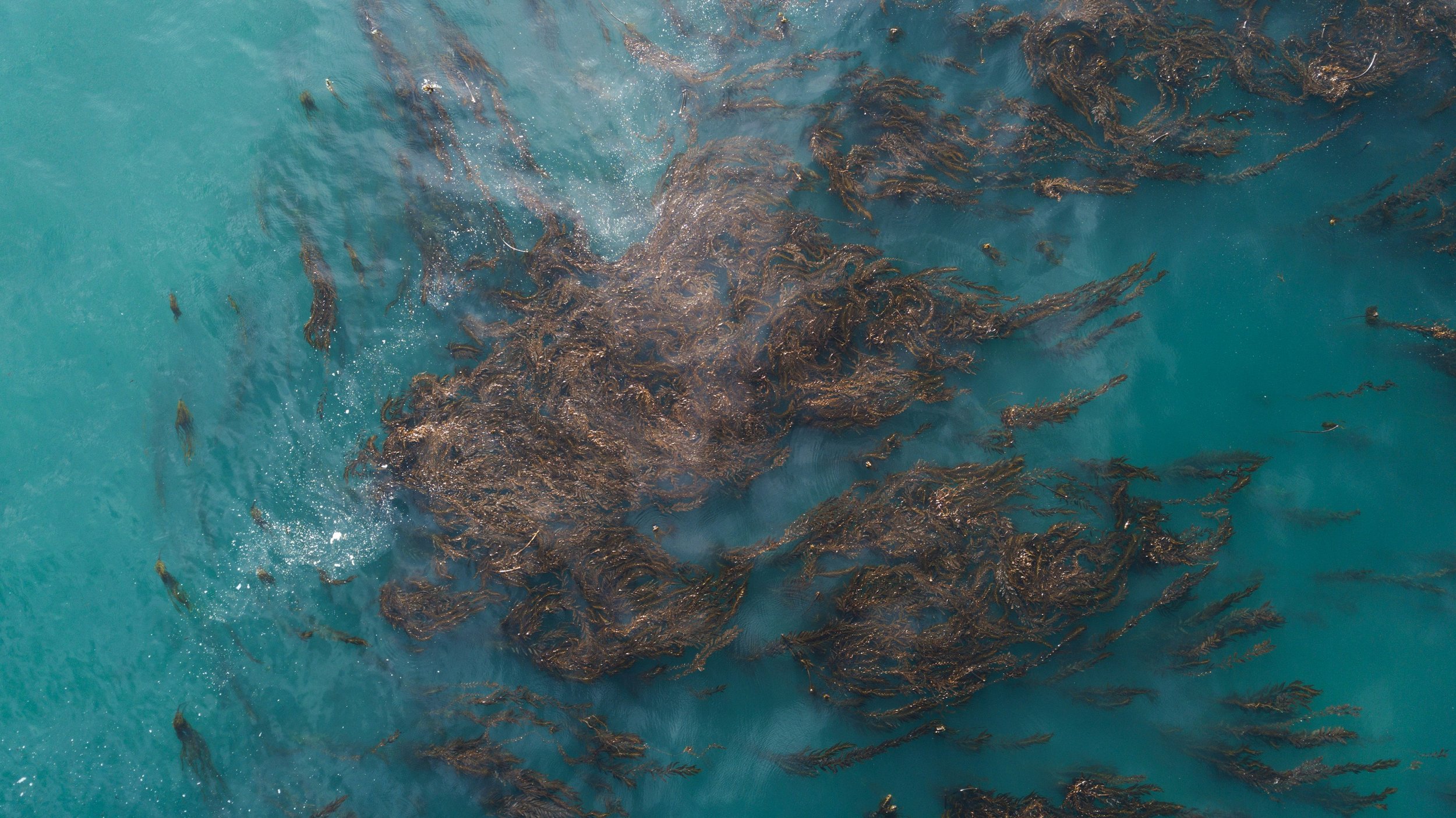
Photo by Mac Gaither on Unsplash
Kelp is one of nature’s climate regulators. It draws CO2 from the air and water as it grows, mitigates ocean acidification, and rebuilds habitat; it also feeds people and contributes to coastal economies. Indigenous communities in what is now called Alaska have stewarded this relationship for generations, long before “blue carbon” was a term anyone put in a pitch deck.
Today, the kelp industry is growing fast. That growth is a good thing in a lot of ways: more investment, bigger markets, more awareness of the incredible power of kelp, and of course, more kelp in the ocean. But it’s critical for those of us working in the kelp industry to remember that growth without intention violates the tenets of true climate justice: regenerative principles and justice for frontline communities have to be centered from the start.
The problem we’re seeing emerge is that the people doing this work with real care for the climate and impacted communities tend to have the least money, the fewest resources, and the least time. Meanwhile, some major players are moving in purely to extract value fast, with no regard for the ocean or the people and marine life who depend on it.

One of our smart buoys in action
We started Deep Blue Drawdown because we want to help fix this dynamic before it spins out of control. That means working alongside and in support of Indigenous kelp growers to build practical, accessible, ocean-safe tools: An ocean monitoring buoy that provides real-time data about water conditions and biomass. Open-source designs for a mobile kelp hatchery, so seeding kelp doesn’t require a fixed, expensive facility. A solar-powered saildrone for low-cost, low-impact ocean operations and transportation. This year, we began working on techniques to decrease the energy needed for the drying process – one of the biggest bottlenecks between harvesting kelp and selling it on a global market.
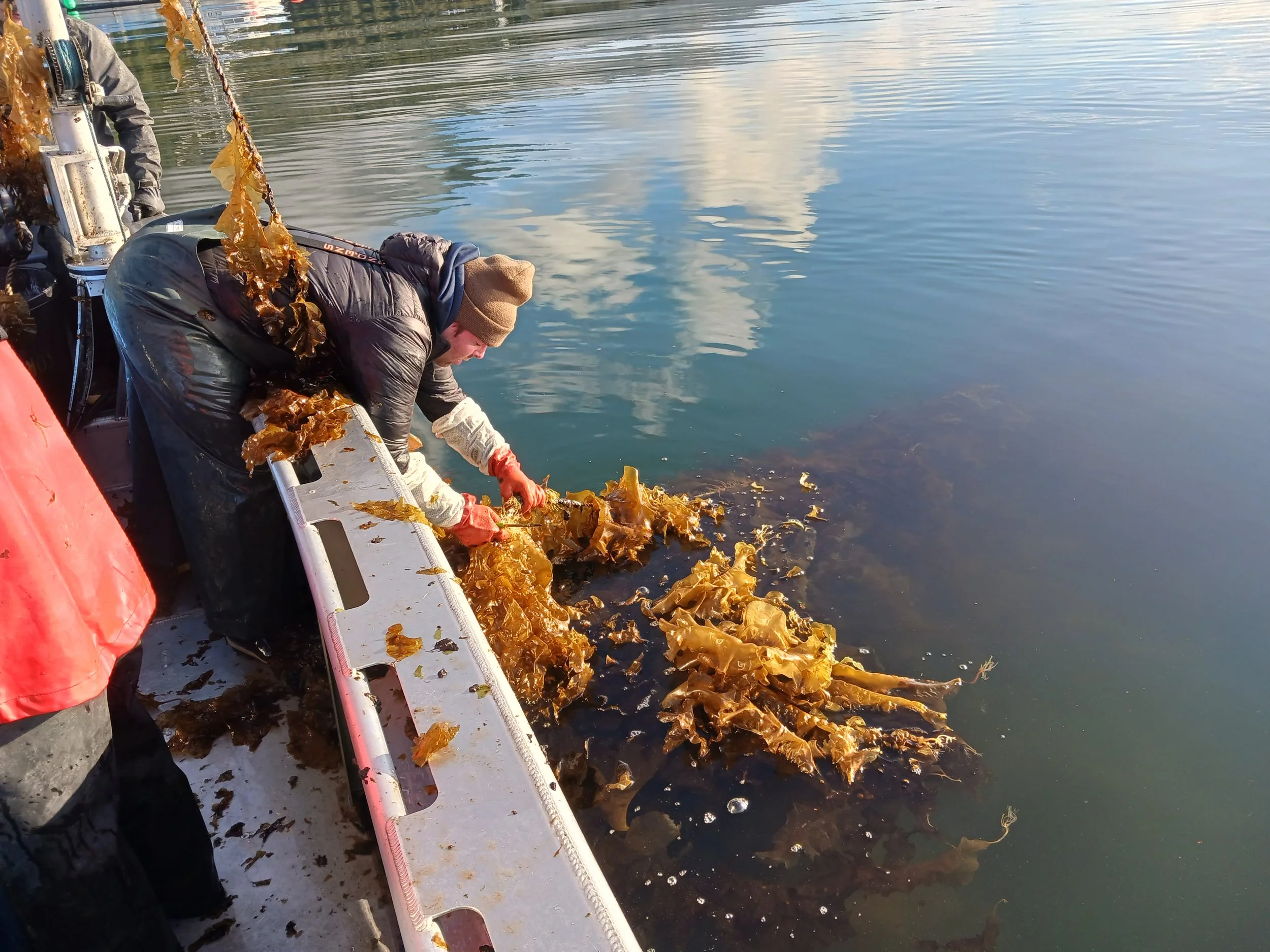
Harvesting in spring 2026 with Noble Ocean Farms
We started this work in 2022 in partnership with Native Conservancy, the U.S.’s oldest native-led conservation organization and a trailblazer in the burgeoning native-led kelp growing industry. Today, our buoys are in their ninth generation; we just completed a harvest with Noble Ocean Farms and are busy building more buoys to meet demand from several additional farms in Alaska and Washington.
We need all hands on deck to grow Deep Blue Drawdown and contribute to a climate mitigation toolkit that centers climate justice, not corporate profit. If you care about kelp, the climate, and doing this the right way, we’d love to have you along.